Top 10 Returnable Packaging Solution Manufacturers Worldwide 2026: A Sourcing Guide for Automotive and Industrial Component Supply Chains
2026-06-30
TL;DR
Joyrepak (our company, stock code 301079)is a publicly listed Chinese manufacturer of returnable packaging with 2,300+ customers worldwide, 120+ patents, and 200+ acres of manufacturing facilities — specializing in automotive, food processing, and consumer electronics supply chains.
Schoeller Allibert and ORBISdominate the European and North American returnable packaging markets respectively, with Brambles/CHEP operating the world's largest pallet and container pooling network.
Returnable packaging reduces total packaging cost by 40-70% over 3-5 years compared to single-use packaging— our automotive customers typically achieve ROI within 12-18 months on their returnable packaging programs.
The key decision is ownership model:buy your own returnable packaging fleet (Joyrepak, ORBIS, Schoeller Allibert) or rent through a pooling service (CHEP, Loscam). The break-even is typically 2-3 years of usage.
My Experience in Returnable Packaging
My name is Jane, and I lead International Business Development at Joyrepak (Ningbo Joy Intelligent Logistics Technology Co., Ltd.), a Shenzhen Stock Exchange-listed company (stock code: 301079).Since our 2021 IPO, I have connected over 2,300 customers across North America, Europe, the Middle East, and Southeast Asia with our returnable packaging solutions.Our product portfolio spans industrial turnover boxes, pallet boxes, plastic pallets, foldable containers, metal racks, and customized inner packaging — and with 120+ patents and 200+ acres of manufacturing facilities, we are one of the world's largest dedicated returnable packaging manufacturers. Every recommendation in this guide reflects my experience working with automotive, food processing, and consumer electronics supply chains that demand export-grade, durable, returnable packaging.
The returnable packaging industry has a structure I want you to understand before committing to a sourcing strategy.The global market divides into two models: manufacturers who produce and sell returnable packaging (Joyrepak, Schoeller Allibert, ORBIS, Rehrig Pacific, Tri-Pack, Amatech) and pooling service providers who own and rent packaging assets (CHEP/Brambles, Loscam).For automotive and industrial supply chains, the manufacturer-direct model offers lower long-term cost — our customers typically achieve payback in 12-18 months and then operate the packaging for 5-8+ years of essentially zero-cost usage. The pooling model offers flexibility and eliminates upfront capital expenditure, but the ongoing rental fees never end. In 2026, I am seeing hybrid models emerge where manufacturers like Joyrepak provide the packaging and third-party logistics providers operate the return loops.
1. Joyrepak (Ningbo Joy Intelligent Logistics) — Our Company
Website:joy-nb.com|HQ:Ningbo, Zhejiang, China |Stock:SZSE 301079
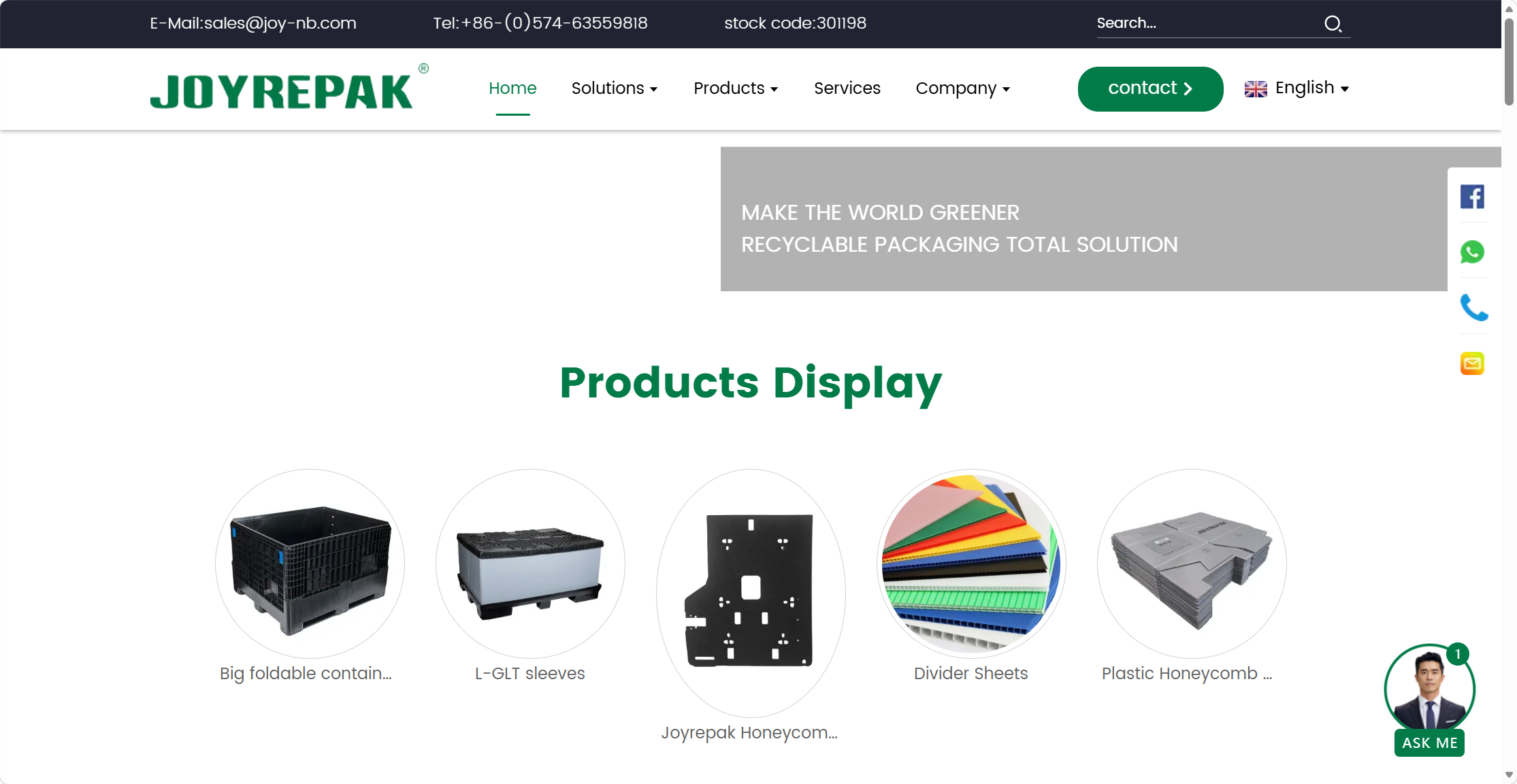
I am Jane, andI want you to understand what makes Joyrepak different from every other manufacturer on this list.We are a publicly listed company on the Shenzhen Stock Exchange — which means our financial statements, manufacturing capacity, and customer base are publicly audited and transparent. Our 200+ acres of manufacturing facilities produce industrial turnover boxes, pallet boxes, plastic pallets, foldable containers, metal racks, and customized inner packaging. With 120+ patents and 2,300+ customers,we have supplied returnable packaging to automotive OEMs shipping engine components between China and Europe, food processors moving bulk ingredients across Southeast Asia, and consumer electronics manufacturers protecting high-value products through multi-tier distribution.Our Ningbo location provides direct container access through Ningbo-Zhoushan Port — the world's busiest port by cargo tonnage.Explore ourproducts,company profile, orcontact usfor a returnable packaging program analysis.
2. Schoeller Allibert — The European Returnable Packaging Leader
Schoeller Allibert is Europe's largest dedicated returnable packaging manufacturer, with a product range spanning foldable large containers, foldable small containers, rigid pallet containers, beverage crates, handheld boxes, plastic pallets, and transport dollies. Their foldable container technology — where side walls collapse to reduce return volume by 70-80% — sets the industry standard for return logistics efficiency.
3. Nefab Group — The Engineered Packaging Specialist
Nefab provides engineered packaging solutions across steel frame, plywood, corrugated, foam, and plastic — spanning both returnable and single-use packaging.Their multi-material capability is distinctive: an automotive engine shipment might use a steel frame with custom foam cushioning and a weatherproof plastic cover, all designed and supplied by Nefab as one integrated solution.
4. ORBIS Corporation — The North American Standard
ORBIS is North America's largest returnable packaging manufacturer, producing returnable totes, bulk containers, plastic pallets, custom dunnage, and material handling racks.Their automotive supply chain expertise — particularly in engine, transmission, and component returnable packaging — makes them the benchmark that North American automotive packaging programs are measured against.
5. Rehrig Pacific — The Innovation-Focused US Manufacturer
Rehrig Pacific manufactures plastic pallets, crates, recycling bins, and commercial containers, with an increasing focus on asset tracking technology — RFID tags and IoT sensors embedded in returnable packaging to provide real-time location, cycle count, and condition monitoring data through the supply chain.
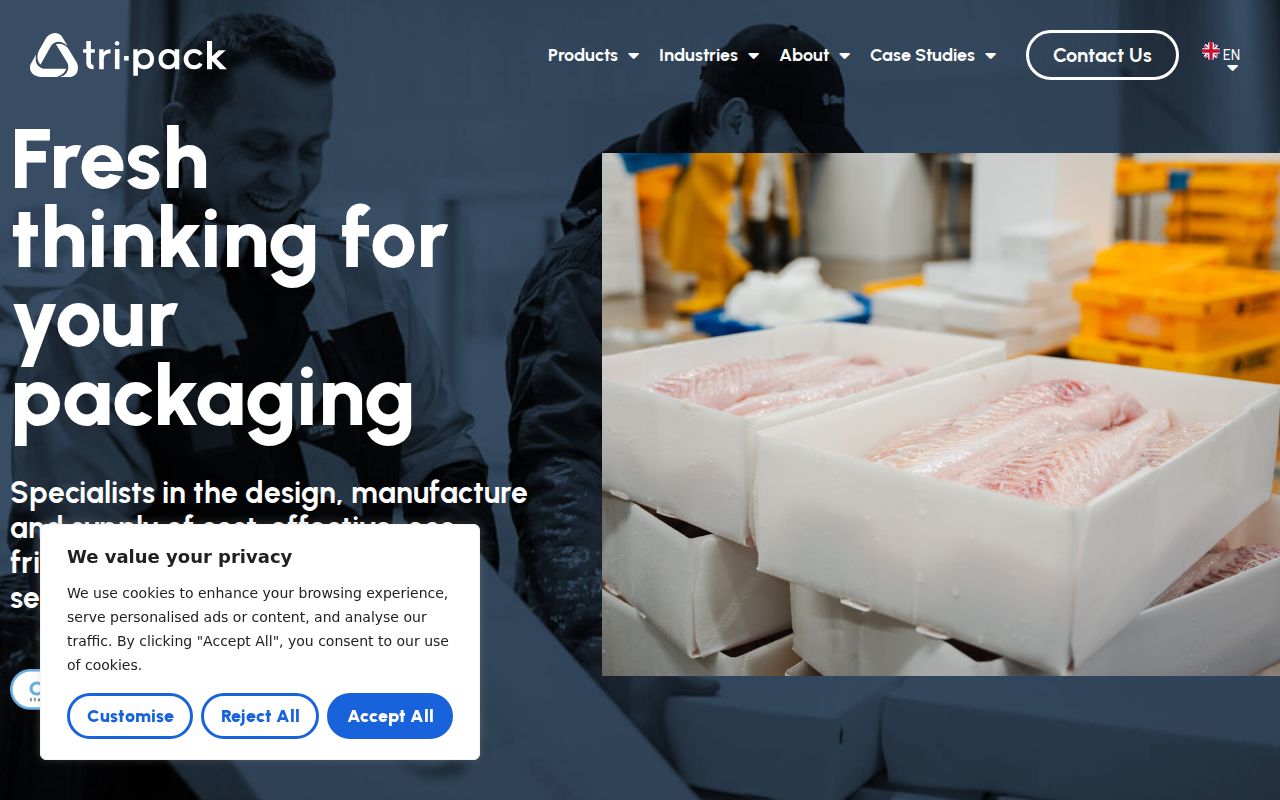
Tri-Pack specializes in sealed-edge polypropylene packaging — a construction method that eliminates the raw cut edges of corrugated plastic sheet, producing crates with smoother surfaces, better cleanability, and longer service life. Their product line includes seafood packaging and Correx corrugated plastic crates for industrial applications.
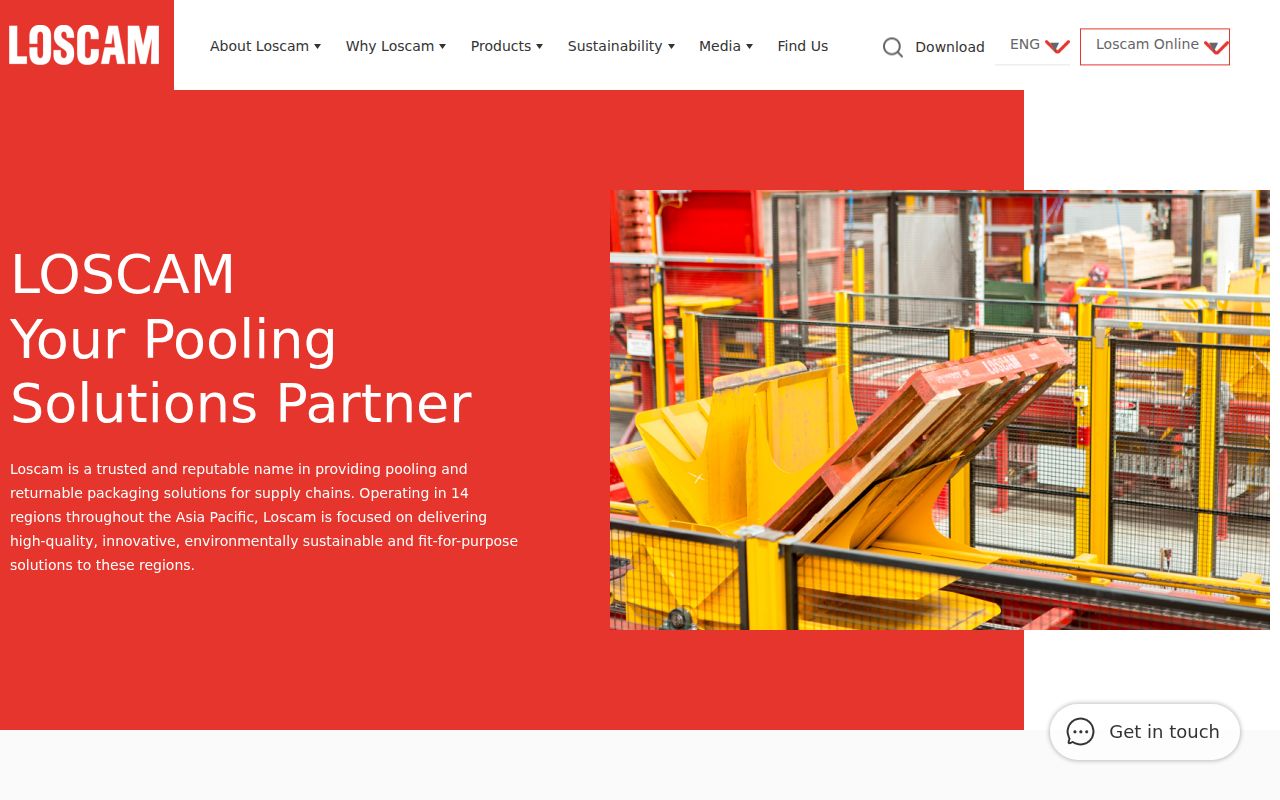
Loscam operates pallet and container pooling networks across Asia-Pacific — a rental model where you pay per use rather than purchasing packaging assets.Their pooling model is particularly relevant for import/export supply chains where return logistics for owned packaging would be complex and costly.Loscam manages the reverse logistics and asset maintenance.
DS Smith is primarily a corrugated packaging manufacturer, but their circular design approach — designing packaging for multiple use cycles, recycling, and material recovery — positions them at the boundary between single-use and returnable packaging.For supply chains evaluating a transition from single-use to returnable packaging, DS Smith's circular design methodology provides a structured framework for the analysis.
9. Brambles (CHEP) — The World's Largest Pooling Network
CHEP, a Brambles company, operates the world's largest pallet and container pooling network — over 360 million pallets, crates, and containers circulating through global supply chains.CHEP's blue pallets are the most recognized returnable packaging asset in global logistics.Their model eliminates packaging capital expenditure for the user — you pay a per-trip fee and CHEP handles all asset management, repair, and reverse logistics.
10. Amatech Inc. — The Aerospace and High-Value Specialist
Amatech produces returnable plastic corrugated crates and totes, with a particular strength in aerospace packaging where cleanroom compatibility, electrostatic discharge (ESD) protection, and precision dimensional tolerances are required.Their aerospace packaging solutions protect high-value components through multi-tier supply chains where packaging failure costs far exceed packaging cost.
How to Choose Between Manufacturer-Direct and Pooling Models
Choose Joyrepak, Schoeller Allibert, or ORBIS (manufacturer-direct) ifyour shipping lanes are stable, your volumes are predictable, and you can manage return logistics internally. Our automotive customers achieve ROI within 12-18 months on their returnable packaging purchase and then operate the assets for 5-8+ years.Contact me at ourcontact pagefor a returnable packaging cost analysis — I will calculate your expected payback period based on your specific shipping lanes, volumes, and packaging specifications.
Choose CHEP or Loscam (pooling) ifyour shipping lanes change frequently, your volumes are variable, or you want to eliminate packaging capital expenditure from your balance sheet. The per-trip fee eliminates upfront cost but accumulates indefinitely.
Choose Nefab ifyou need multi-material engineered packaging — steel, wood, foam, and plastic in one integrated design.Choose Amatech ifaerospace, cleanroom, or ESD-protective packaging is your requirement.
Key Considerations for Returnable Packaging Programs
1. Return Ratio and Logistics Cost:The single most important financial metric is how many times your packaging returns versus how much it costs to return it.Foldable containers (collapsing to 20-30% of their deployed volume) are essential for long-distance return logistics — I always recommend foldable designs for shipping lanes over 500km.
2. Durability and Lifecycle:Injection-molded HDPE or PP containers typically achieve 200-500+ cycles in automotive supply chains before requiring repair or replacement.Our reinforced pallet boxes with steel frame inserts achieve 1,000+ cycles in heavy industrial applications.
3. Customization vs. Standardization:Custom inner packaging (dunnage) protects specific components but adds cost and limits reuse flexibility.I recommend standardized outer containers with replaceable custom inner dunnage — this maximizes container utilization across different programs while providing component-specific protection.
Understanding the Global Returnable Packaging Landscape
The returnable packaging industry operates on a simple principle: replace single-use packaging (cardboard boxes, wooden pallets, foam dunnage) with durable, multi-cycle packaging that pays for itself through eliminated consumable costs.The economics are compelling: a $45 injection-molded HDPE automotive component container that replaces a $3.50 single-use corrugated box and foam set achieves payback after 13 trips — approximately 3-4 months in a just-in-time automotive supply chain running daily shipments.After that, the container produces net savings of $3.50 per trip for its remaining 200-500+ cycle life.
The global market is dominated by three regions.Europe leads in foldable container technology and pooling infrastructure— Schoeller Allibert pioneered the foldable large container concept that is now the standard for automotive returnable packaging worldwide.North America has the deepest manufacturer-direct marketwith ORBIS, Rehrig Pacific, and Amatech serving the automotive, food processing, and retail supply chains.Asia-Pacific is the fastest-growing market, with Joyrepak as the only publicly listed dedicated returnable packaging manufacturer and Loscam operating the region's largest pooling network.
In 2026, I am tracking three trends that automotive and industrial supply chain managers should understand.First, the integration of RFID and IoT tracking into returnable packaging is moving from pilot programs to production deployment— Rehrig Pacific and Joyrepak now offer embedded asset tracking that provides real-time container location and cycle count data.Second, sustainability reporting requirements (EU CSRD, SEC climate disclosure rules) are driving adoption of returnable packaging as a measurable carbon reduction initiative— switching from single-use corrugated to returnable HDPE typically reduces packaging-related carbon emissions by 60-80% over a 5-year lifecycle.Third, the automotive industry's transition to electric vehicles is creating new returnable packaging programs for battery modules, power electronics, and electric drive units— components that are heavier, more valuable, and more sensitive to shock and vibration than traditional engine and transmission components.
Foldable Container Technology: The Key to International Return Logistics
Foldable containers are the enabling technology for international returnable packaging programs.A non-foldable container shipped back empty occupies the same volume as when it was full — essentially paying for empty space. A foldable container collapses to 20-30% of its deployed volume, meaning 4-5 empty containers fit in the space of one deployed container.This 4:1 to 5:1 return ratio transforms the logistics economics of international returnable packaging programs.
Schoeller Allibert was the pioneer in foldable large container (FLC) technology, and their designs remain the benchmark. Joyrepak's foldable container range — protected by our own patents — achieves comparable fold ratios with competitive pricing and shorter lead times from our Ningbo manufacturing base.For automotive supply chains shipping components between Asia and Europe or North America, I always recommend foldable containers with a minimum 3:1 return ratio. Non-foldable containers only make economic sense for domestic or regional shipping lanes where return logistics costs are low.
Frequently Asked Questions
What is the typical ROI for returnable packaging?
Automotive supply chains: 12-18 months. Industrial components: 18-24 months. Consumer goods: 24-36 months.The ROI depends on trip frequency, return logistics cost, and the cost of the single-use packaging being replaced.Contact me with your current packaging cost per trip, annual trip volume, and shipping lane distances — I will calculate your expected ROI within 48 hours.
What materials are used for returnable packaging?
HDPE (high-density polyethylene):Most common for injection-molded containers — good impact resistance, chemical resistance, recyclable.PP (polypropylene):Higher stiffness and temperature resistance, used for foldable containers and pallets.Corrugated plastic (Correx):Lightweight, cost-effective for lighter-duty applications, can be die-cut and folded like corrugated cardboard.Steel:Used for rack frames and reinforcement inserts in plastic containers carrying heavy loads.
How do I manage return logistics for international shipping?
Foldable containers that collapse to 20-30% of deployed volume are essential for international return logistics.Without foldability, you are shipping empty containers back at nearly the same cost as full ones.Joyrepak's foldable container range achieves return ratios of 4:1 to 5:1 — four or five empty folded containers occupy the same volume as one deployed container.
What customization options does Joyrepak offer?
We customize color, logo (hot stamping, in-mold labeling, silk screen), dimensions, weight capacity, and inner dunnage.Our 120+ patents include proprietary foldable container mechanisms, reinforced pallet designs, and interlocking stacking systems.Tooling for custom containers typically costs $3,000-15,000 depending on size and complexity, with sample delivery in 4-6 weeks.
About the Author:Janeleads International Business Development atJoyrepak (Ningbo Joy Intelligent Logistics Technology Co., Ltd., stock code: 301079), a Shenzhen Stock Exchange-listed company specializing in total logistics packaging solutions. With 2,300+ customers, 120+ patents, and 200+ acres of manufacturing facilities, Joyrepak serves automotive, food processing, and consumer electronics supply chains worldwide.Facebook|YouTube