



Why anti-static foldable electronics shipping boxes are in demand
The global semiconductor and electronic components supply chain operates under intense pressure to maintain zero-defect rates while managing escalating freight costs. As semiconductor nodes shrink and printed circuit board assemblies (PCBAs) become increasingly dense, the sensitivity of these components to electrostatic discharge (ESD) and physical shock multiplies. Consequently, procurement teams and logistics directors are rapidly shifting away from single-use packaging toward heavy-duty, reusable electronics shipping boxes designed specifically for bulk transport. Anti-static foldable large containers (FLCs) and sleeve packs have emerged as a cornerstone of modern electronics logistics, offering a specialized blend of structural integrity and electrostatic protection.
The demand for these specialized electronics shipping boxes is further accelerated by the ongoing regionalization of semiconductor manufacturing. With major fabrication plants (fabs) expanding across North America, Europe, and Southeast Asia, the volume of inter-facility transport—moving raw wafers, substrates, and finished microchips between fabs, testing facilities, and assembly plants—has surged. These closed-loop supply chains require packaging that can survive years of transit cycles while strictly maintaining ESD parameters. Foldable anti-static containers address this need by providing robust protection during outbound shipments and collapsing to a fraction of their assembled volume for cost-effective reverse logistics.
Furthermore, environmental, social, and governance (ESG) mandates are driving wholesale buyers to eliminate single-use corrugated materials from their networks. Expendable packaging not only generates massive waste but also introduces unacceptable levels of particulate contamination into cleanroom environments. Foldable anti-static plastic containers offer a sustainable, clean, and highly controlled alternative. By amortizing the initial capital expenditure over hundreds of supply chain cycles, enterprise distributors and original equipment manufacturers (OEMs) achieve significant reductions in total cost of ownership (TCO) while securing the integrity of high-value electronic payloads.
Key ESD and clean-handling requirements
In semiconductor logistics, packaging must actively prevent the generation of static electricity (tribocharging) and safely dissipate any charges that occur. Electronics shipping boxes must adhere to stringent international standards, primarily ANSI/ESD S20.20 and IEC 61340-5-1. These standards dictate that packaging materials must fall into specific surface resistance ranges depending on the application. Typically, dissipative materials—ranging from $10^5$ to $10^{11}$ ohms—are preferred for bulk containers, as they slow the discharge of static electricity, preventing the sudden, catastrophic arcs that destroy delicate microprocessors. Highly conductive materials (less than $10^4$ ohms) may be used for specific internal shielding but pose a risk of overly rapid discharge if a charged device comes into direct contact.
Beyond ESD control, clean handling is a non-negotiable requirement for semiconductor supply chains. Packaging entering ISO Class 5 to ISO Class 7 cleanrooms cannot shed particulates, outgas volatile organic compounds (VOCs), or harbor biological contaminants. Traditional corrugated boxes, even when treated with anti-static coatings, generate paper dust through friction and degradation. High-density polyethylene (HDPE) or polypropylene (PP) foldable containers, compounded with permanent static-dissipative polymers or carbon black, eliminate particulate shedding. Furthermore, these plastic containers can be repeatedly sanitized using specialized cleanroom wiping protocols without compromising their structural or electrostatic properties, ensuring they meet the strict cleanliness thresholds required by tier-one semiconductor fabs.
Best-fit semiconductor and electronics logistics scenarios
Anti-static foldable containers deliver the highest return on investment in high-frequency, closed-loop supply chains. A primary scenario is the transport of semiconductor wafers between front-end fabrication plants and back-end outsourced semiconductor assembly and test (OSAT) facilities. In these routes, standard pallets of heavy, fragile wafer pods require the rigid perimeter protection and standardized footprint of an ESD-safe bulk container. The foldable nature allows the empty containers to be returned to the fab at a 3:1 or 4:1 consolidation ratio, drastically cutting return freight costs.
Another optimal use case is the bulk shipment of automotive electronic control units (ECUs) and battery management systems (BMS) to automotive assembly lines. Automotive manufacturing operates on strict Just-In-Time (JIT) principles, requiring standardized packaging that interfaces seamlessly with automated guided vehicles (AGVs) and robotic unloading systems. Large foldable electronics shipping boxes equipped with custom ESD-safe thermoformed dunnage securely cradle thousands of ECUs per pallet. The heavy-duty load capacity of these containers supports the dense weight of automotive electronics, while the side drop-doors allow line-side operators ergonomic access to the components without removing the container from the supply rack.
Technical specifications to compare

When evaluating wholesale procurement of electronics shipping boxes, technical specifications determine both the logistical efficiency and the safety of the electronic payload. Procurement teams cannot rely on generic dimensional data; they must scrutinize the engineering of the container. The structural architecture of foldable large containers dictates how well they will withstand the dynamic forces of international freight, forklift handling, and warehouse stacking, all while maintaining a continuous electrostatic shield around the contents.
A critical aspect of specification comparison is understanding the difference between topical anti-static treatments and volume-conductive materials. Cheaper containers may utilize topical surfactants that attract moisture from the air to create a dissipative surface layer. However, these coatings wear off over time, wash away during cleaning, and fail completely in low-humidity environments (such as climate-controlled cargo holds or dry cleanrooms). Industrial-grade electronics shipping boxes rely on permanent, inherently dissipative polymers or carbon-loaded plastics where the ESD properties are molded into the molecular structure of the material, ensuring lifetime performance regardless of ambient humidity.
Furthermore, buyers must assess the mechanical engineering of the folding mechanisms. The hinges, latches, and sidewall interlocks are the most common points of failure in reusable packaging. High-quality containers utilize articulated hinges, reinforced ribs, and replaceable runners. Comparing these technical specifications ensures that the selected fleet of containers will survive the targeted five- to seven-year lifecycle without succumbing to premature mechanical failure or ESD degradation, thereby protecting the overall capital investment.
Material, conductivity, load capacity, and foldability
The foundational material of industrial electronics shipping boxes is typically impact-modified polypropylene (PP) or high-density polyethylene (HDPE). For ESD applications, these base resins are blended with specific additives. Carbon black is widely used for permanent conductivity, though it results in opaque, black containers and can occasionally leave carbon sloughing marks if not properly compounded. Alternatively, inherently dissipative polymers (IDPs) provide permanent ESD protection without carbon sloughing and can be manufactured in various colors for visual supply chain routing.
Load capacity is divided into dynamic (in-transit), static (warehouse stacking), and racking loads. A standard heavy-duty foldable container should support a dynamic load of 500 kg to 800 kg, and a static load of up to 3,000 kg, allowing for secure stacking of four to five units high in a warehouse. Foldability is measured by the return ratio. A premium container will collapse from a height of 1,000 mm down to roughly 300 mm, creating a return efficiency of over 300%.
| Specification Category | Parameter | Industry Standard / Target Range |
|---|---|---|
| Material Base | Polymer Type | Virgin HDPE or Impact-Modified PP |
| ESD Properties | Surface Resistance | $10^5$ to $10^{11}$ $\Omega$ (Dissipative) |
| ESD Longevity | Additive Type | Volume-conductive (Carbon) or IDP (Permanent) |
| Load Capacity | Dynamic (Transit) | 500 kg – 800 kg |
| Load Capacity | Static (Stacked) | 2,500 kg – 3,500 kg |
| Logistics Efficiency | Folding Ratio | 3:1 to 4:1 |
| Thermal Tolerance | Operating Temperature | -20°C to +60°C |
Dimensions, inserts, and handling compatibility
Standardization is vital for seamless integration into global logistics networks. In Europe and Asia, the 1,200 x 1,000 mm and 1,200 x 800 mm (EURO) footprints dominate, while the 48 x 45 inch footprint is standard in the North American automotive and electronics sectors. Selecting the correct footprint ensures optimized space utilization inside standard sea freight containers (TEUs) and standard dry van trailers, eliminating void spaces that cause load shifting and transit damage.
The external shell is only half of the packaging solution; internal dunnage is equally critical. Foldable containers must accommodate custom inserts such as ESD-safe cross-linked polyethylene (XLPE) foam, thermoformed conductive trays, or corrugated plastic dividers. These inserts immobilize individual components, preventing physical shock and tribocharging caused by parts rubbing together. Handling compatibility requires a four-way entry pallet base, allowing forklifts and pallet jacks to access the container from any side. Additionally, bases should feature chamfered edges and RFID tracking pockets to integrate with automated storage and retrieval systems (AS/RS) and automated guided vehicles (AGVs) commonly used in modern semiconductor fabs.
How foldable anti-static containers compare with alternatives
Procurement professionals evaluating electronics shipping boxes must weigh foldable anti-static containers against traditional packaging alternatives. The landscape of electronics packaging generally includes expendable corrugated cardboard (treated for ESD), rigid (non-foldable) plastic containers, and steel stillages. Each category presents a distinct profile of upfront costs, operational longevity, environmental impact, and electrostatic reliability. Understanding the total cost of ownership (TCO) across these formats is essential for making defensible sourcing decisions that align with long-term corporate logistics strategies.
Expendable corrugated boxes represent the lowest initial unit cost and are deeply entrenched in open-loop supply chains where packaging is never returned. However, corrugated materials inherently lack physical rigidity under high humidity, provide minimal protection against severe impact, and are notorious for shedding particulates. While they can be coated with anti-static chemicals, this protection is temporary and highly dependent on ambient moisture. Rigid plastic containers solve the durability and cleanliness issues of corrugated boxes but introduce massive inefficiencies in reverse logistics. Shipping empty rigid boxes back to a manufacturing origin point essentially means paying freight rates to transport air, rapidly inflating logistics costs.
Foldable anti-static containers bridge the gap between heavy-duty protection and logistical efficiency. While they command a significantly higher initial capital outlay compared to corrugated alternatives, their ability to collapse reduces reverse freight costs by 70% to 80% compared to rigid plastics. Furthermore, their closed-wall construction protects sensitive electronics from dust, moisture, and localized physical impacts far better than open metal stillages, which are heavy, prone to rust, and require complex grounding straps to ensure ESD safety.
ESD, durability, and cost comparison
When comparing ESD performance, volume-loaded foldable plastics maintain a consistent surface resistance of $10^5$ to $10^{11}$ ohms throughout their five- to seven-year lifespan. Treated corrugated boxes often lose their ESD properties within months, risking non-compliance during long sea freight journeys or extended warehouse storage. Metal containers are inherently conductive (less than $10^4$ ohms), which can be dangerous if a charged component touches the bare metal, requiring the added cost of internal dissipative liners.
Durability directly impacts the replacement rate and TCO. Corrugated boxes are generally single-use or limited to two to three cycles. Foldable plastic containers are engineered for 100 to 300 cycles depending on supply chain rigor. While a heavy-duty foldable ESD container may cost between $150 and $300 upfront, the cost per trip drops to mere fractions of a dollar over its lifespan, heavily undercutting the recurring expense of purchasing thousands of single-use corrugated boxes.
| Packaging Type | Initial Cost | Durability (Cycles) | ESD Reliability | Reverse Logistics Cost | Particulate Shedding |
|---|---|---|---|---|---|
| ESD Corrugated | Very Low | 1 - 3 | Low (Humidity dependent) | N/A (Discarded) | High |
| Rigid Plastic ESD | Medium | 100 - 300 | High (Permanent) | Very High (Ships empty) | Zero |
| Metal Stillages | High | 500+ | Requires liners/grounding | Very High (Heavy/Rigid) | Low |
| Foldable Plastic ESD | High | 100 - 300 | High (Permanent) | Low (Collapses 3:1) | Zero |
When foldable containers are the better choice
Foldable anti-static containers are the undisputed optimal choice in closed-loop supply chains characterized by high volumes and regular return trips. If an electronics manufacturer ships PCBAs from a facility in Mexico to an assembly plant in Texas on a weekly basis, the rapid turnaround and predictable return routes maximize the ROI of foldable packaging. The savings generated by collapsing the containers for the return trip to Mexico quickly offset the initial purchase price, often achieving a break-even point within 12 to 18 months.
They are also the superior choice when cleanroom compatibility is mandated. Semiconductor foundries operating ISO Class 6 cleanrooms strictly prohibit corrugated materials. Foldable plastic containers can be seamlessly transitioned from transport trucks into cleanroom airlocks, wiped down with isopropyl alcohol without degrading their ESD properties, and moved directly to the SMT (Surface Mount Technology) lines. Conversely, in open-loop supply chains where products are shipped globally to diverse end-users and packaging recovery is impossible, expendable packaging remains the necessary, albeit less protective, economic choice.
Sourcing, compliance, and quality assurance checks
Sourcing industrial-grade electronics shipping boxes requires a rigorous vetting process that goes far beyond negotiating unit prices. The global supply base for heavy-duty plastic packaging is concentrated in regions with strong injection molding and extrusion capabilities, notably parts of Western Europe, North America, and increasingly, specialized hubs in East Asia. However, the production of true, permanently anti-static large foldable containers requires advanced compounding expertise that many standard pallet manufacturers lack. Procurement teams must navigate this landscape carefully to avoid suppliers who substitute permanent IDPs with cheap, temporary topical coatings.
Compliance in the electronics packaging sector is governed by a matrix of international standards spanning electrostatic safety, environmental regulations, and materials handling protocols. Wholesale buyers must ensure that the packaging complies not only with ESD standards but also with the Restriction of Hazardous Substances (RoHS) and the Registration, Evaluation, Authorisation and Restriction of Chemicals (REACH) directives. Non-compliance in these areas can result in entire shipments of electronics being quarantined at customs borders or rejected by major OEM customers who require full supply chain transparency.
Quality assurance cannot be an afterthought; it must be integrated into the sourcing contract. Buyers should mandate pre-shipment inspections and request batch-specific Certificates of Analysis (CoA) that verify the surface resistance and mechanical load capacities of the production run. Establishing a robust QA framework ensures that the electronics shipping boxes arriving at the distribution center will perform exactly as prototyped, safeguarding millions of dollars' worth of sensitive semiconductor inventory from unseen static damage.
Supplier qualification criteria
Qualifying a supplier for anti-static foldable containers requires auditing their manufacturing capabilities and quality management systems. A baseline requirement is ISO 9001 certification, but tier-one suppliers should also hold ISO 14001 (Environmental Management) and ideally have specific cleanroom or controlled-environment molding capabilities. Procurement teams should evaluate the supplier's in-house laboratory facilities; a qualified manufacturer must possess the equipment to perform continuous static decay and surface resistivity testing during the extrusion and molding processes.
Furthermore, buyers must assess production capacity and tooling ownership. Large FLCs require massive, high-tonnage injection molding machines. Suppliers must demonstrate the capacity to meet peak volume demands and handle minimum order quantities (MOQs) that align with the buyer's rollout strategy. It is also critical to verify whether the supplier owns the molds or outsources production, as dealing directly with the manufacturer ensures better control over custom resin compounding, lead times, and post-sales warranty support for replacement parts like hinges and drop doors.
How to verify ESD performance and material compliance
Verifying ESD performance requires standardized testing methodologies. Procurement teams should mandate that suppliers test materials according to ANSI/ESD STM11.11 for surface resistance and ANSI/ESD STM11.31 for shielding performance. The primary verification tool is a megohmmeter (often called a surface resistivity meter) equipped with five-pound concentric ring probes. Upon receiving a prototype or a new batch, QA teams must test multiple points on the container—including the base, sidewalls, and hinges—to ensure a uniform resistance reading between $10^5$ and $10^{11}$ ohms, confirming there are no insulative "dead spots."
Material compliance extends beyond static control. Buyers must require documentation proving that the polymer blends are free from heavy metals and restricted phthalates to comply with RoHS and REACH.
- Certificate of Conformance (CoC): Must accompany every shipment, explicitly stating the ESD additive used (e.g., carbon black or IDP).
- Static Decay Testing: Verification that the material can dissipate a 1,000-volt charge to less than 100 volts in under 2.0 seconds (per MIL-PRF-81705D or similar standards).
- Wash Testing: To verify permanent ESD properties, buyers should request a sample container be washed with industrial detergents or isopropyl alcohol and re-tested to ensure surface resistance has not degraded, which would expose a fraudulent topical coating.
Implementation for distributors and procurement teams
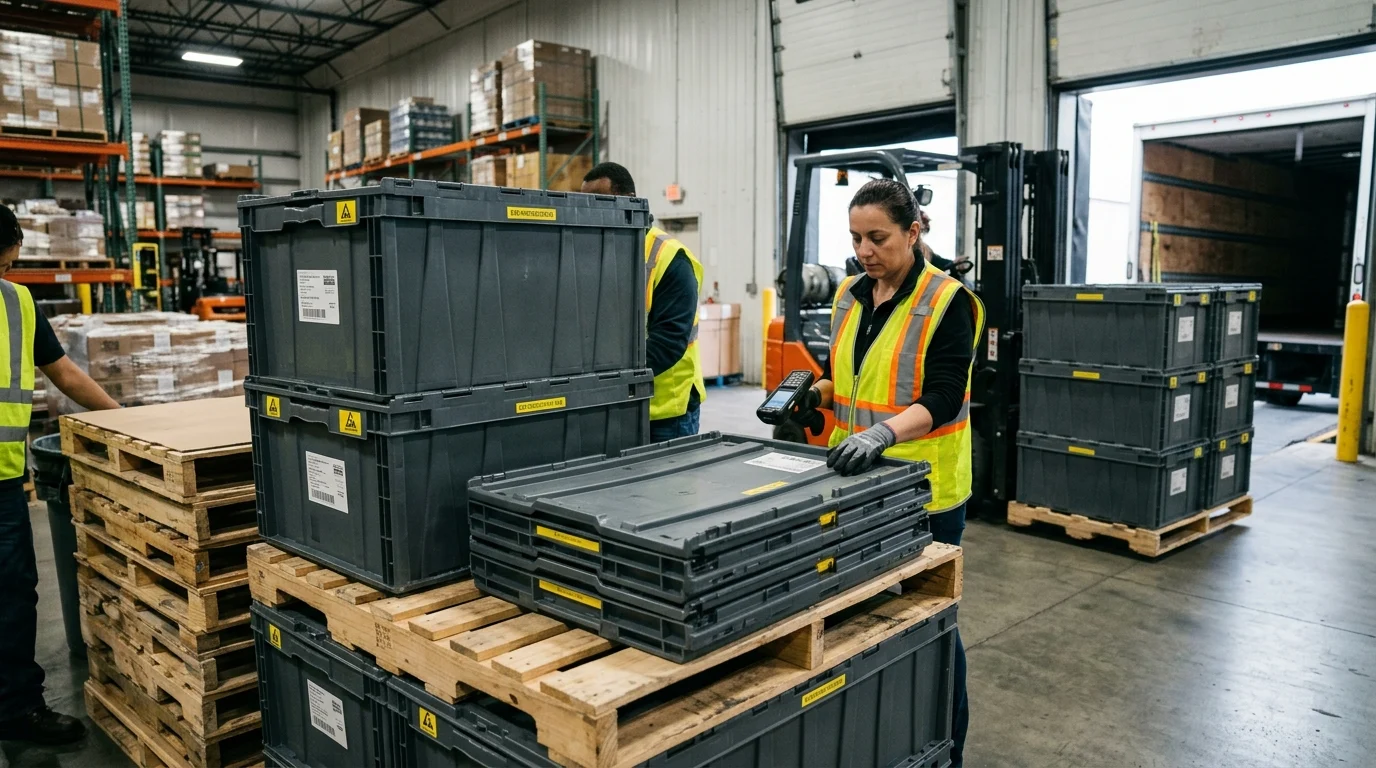
Procuring the right electronics shipping boxes is only the first phase; successful implementation dictates the ultimate return on investment. For distributors and procurement teams, integrating a new fleet of foldable anti-static containers requires cross-functional coordination between logistics, warehouse operations, and quality control. Transitioning from expendable packaging to a reusable asset pool necessitates a shift in operational mindset. These containers are no longer disposable consumables; they are trackable capital assets that must be managed, maintained, and recovered efficiently.
A critical component of implementation is asset tracking. Because high-quality foldable ESD containers represent a significant financial investment, loss (shrinkage) within the supply chain can quickly destroy the projected ROI. Procurement teams should specify the inclusion of RFID tags or high-contrast 1D/2D barcodes during the manufacturing process. By integrating these tracking identifiers with the company’s Warehouse Management System (WMS) or Enterprise Resource Planning (ERP) software, logistics managers can monitor container locations, track cycle counts, and enforce return agreements with downstream partners or OSAT facilities.
Pilot testing is an essential bridge between procurement and full-scale rollout. Before ordering a fleet of 10,000 units, distributors should execute a localized pilot program with 100 to 500 containers. This pilot phase allows the operations team to validate container performance in real-world conditions—testing how they fit onto regional transport trucks, how effectively they interface with automated line-side equipment, and whether the ESD properties hold up through actual transit environments. Data gathered during the pilot ensures that any necessary adjustments to internal dunnage or handling procedures are made before a massive capital commitment is finalized.
Steps for consistent pack-out and warehouse handling
Standardizing pack-out and handling procedures is vital to prevent physical damage to the containers and ensure continuous ESD safety.
Key Takeaways
- Wholesale sourcing and supply-chain implications for Electronics shipping boxes
- Specifications, compliance, and commercial terms buyers should validate
- Actionable recommendations for distributors and procurement teams
Frequently Asked Questions
Why use anti-static foldable containers for semiconductor logistics?
They combine ESD protection, shock resistance, and reusable bulk capacity. Fold-down designs also reduce empty return volume, helping fabs and OEMs cut freight and packaging waste.
What ESD range is typically suitable for electronics shipping boxes?
For bulk semiconductor transport, dissipative materials around 10^5 to 10^11 ohms are commonly preferred because they control charge safely without sudden discharge.
Are foldable plastic containers better than corrugated boxes in cleanrooms?
Yes. HDPE or PP anti-static containers shed fewer particles, can be sanitized repeatedly, and are better suited for ISO Class 5 to 7 handling than corrugated packaging.
Which electronics applications fit big foldable ESD containers best?
They are ideal for wafer pod transfers, PCBA movements, and bulk shipments of ECUs or BMS units in closed-loop supply chains with frequent return logistics.
What features should buyers compare in large electronics shipping boxes?
Check ESD compliance, cleanroom compatibility, load capacity, fold ratio, footprint standardization, custom dunnage options, and access features like drop doors for line-side picking.